Transport Invoice Explained: EU Rules, VAT & How It Works
In this guide, you will learn what a transport invoice is, what information it must contain, how VAT works in EU transport, and how to correctly issue invoices for domestic and international shipments.
What Is a Transport Invoice?
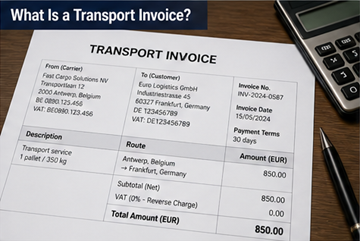
A transport invoice is a document issued by a carrier or logistics provider to charge a customer for transport services. It details the cost of moving goods from one location to another and serves as an official request for payment.
Transport invoices are used in all types of logistics operations, including road, air, and sea freight. In Europe, they must comply with VAT regulations and include specific legal information.
- Issued by carrier or transport provider
- Sent to customer or shipper
- Includes price and service details
- Used for accounting and tax reporting
- Required for payment processing
What Must a Transport Invoice Include?
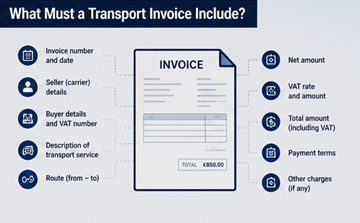
A valid transport invoice must include certain mandatory details to comply with EU tax regulations. Missing information can lead to legal or accounting issues.
- Invoice number (unique and sequential)
- Invoice date
- Carrier company name and address
- Customer (billing party) details
- VAT number of both parties (if applicable)
- Description of transport service
- Route (pickup and delivery locations)
- Price (net amount)
- VAT rate and VAT amount
- Total amount (including VAT)
- Payment terms (e.g., 30 days)
How Does VAT Work for Transport in the EU?
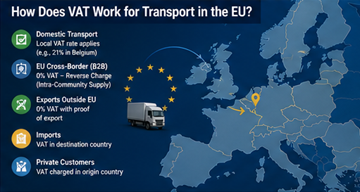
VAT (Value Added Tax) rules for transport services in the EU depend on the type of customer, the countries involved, and the nature of the transport.
For business-to-business (B2B) transport services, VAT is usually handled under the reverse charge mechanism or intra-community supply rules.
- Domestic transport: local VAT applies (e.g., 21% in Belgium)
- EU cross-border (B2B): usually 0% VAT (reverse charge)
- Exports outside EU: 0% VAT (with proof of export)
- Imports: VAT handled in destination country
- Private customers: VAT usually charged in origin country
Transport Invoice Example (Breakdown)
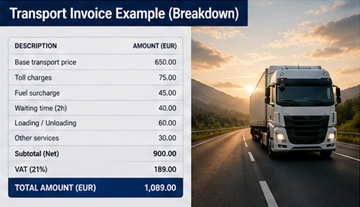
A transport invoice often includes multiple cost components beyond the base transport price. These must be clearly listed for transparency.
- Base transport price
- Toll charges
- Fuel surcharge
- Waiting time
- Customs or border costs
- Additional services (loading, unloading)
- Total price calculation
When Is a Transport Invoice Issued?
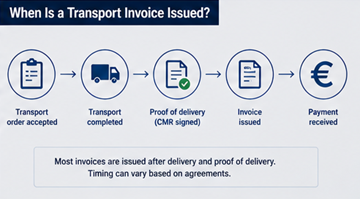
Transport invoices are typically issued after the transport service is completed. However, the exact timing may depend on agreements between the parties.
- After delivery is completed (most common)
- After proof of delivery (CMR signed)
- Periodically (e.g., twice per month)
- Based on contract agreements
- Sometimes partially in advance (rare)
Transport Invoice vs Proforma Invoice
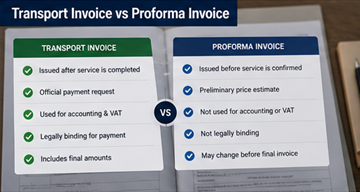
A transport invoice is often confused with a proforma invoice, but they serve different purposes.
- Transport invoice: official payment request
- Proforma invoice: preliminary price estimate
- Transport invoice: used for accounting and VAT
- Proforma invoice: used before service is confirmed
- Transport invoice: legally binding for payment
How Platforms Like ExusTrans Handle Invoicing
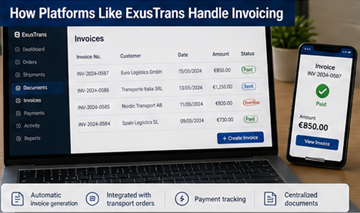
Modern logistics platforms automate the invoicing process, making it easier for both customers and carriers to manage payments and documentation.
- Automatic invoice generation
- Integration with transport orders
- Tracking of payments and status
- Centralized document storage
- Support for VAT and cross-border rules
Common Mistakes to Avoid
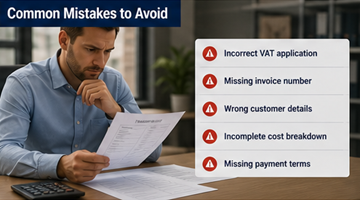
Incorrect invoices can lead to delayed payments, tax issues, or disputes. Always verify the details carefully.
- Incorrect VAT application
- Missing invoice number
- Wrong customer details
- Incomplete cost breakdown
- Missing payment terms
FAQ: Transport Invoice Explained
Is VAT always required on transport invoices?
No. VAT depends on the type of transport and customer. For EU B2B transport, VAT is often 0% under reverse charge rules.
What VAT applies in Belgium?
Domestic transport in Belgium typically uses 21% VAT unless special rules apply.
When do I issue a transport invoice?
Usually after delivery is completed and confirmed by proof of delivery (CMR).
Can I invoice before delivery?
Yes, but it is less common. Most transport invoices are issued after service completion.
What happens if VAT is applied incorrectly?
It can lead to tax corrections, penalties, or rejected invoices. Always follow EU VAT rules.
Do I need a separate invoice for each transport?
Not always. Some companies issue periodic invoices (e.g., twice per month) covering multiple transports.
eXus Dev